PhD student · ICT, Chinese Academy of Sciences

Haocun Ye叶浩存

Multimodal large models — training, RLVR post-training, and trustworthy evaluation. Advised by Prof. Yiqiang Chen.

“When a benchmark score goes up, did the model actually acquire the ability the benchmark claims to measure?”
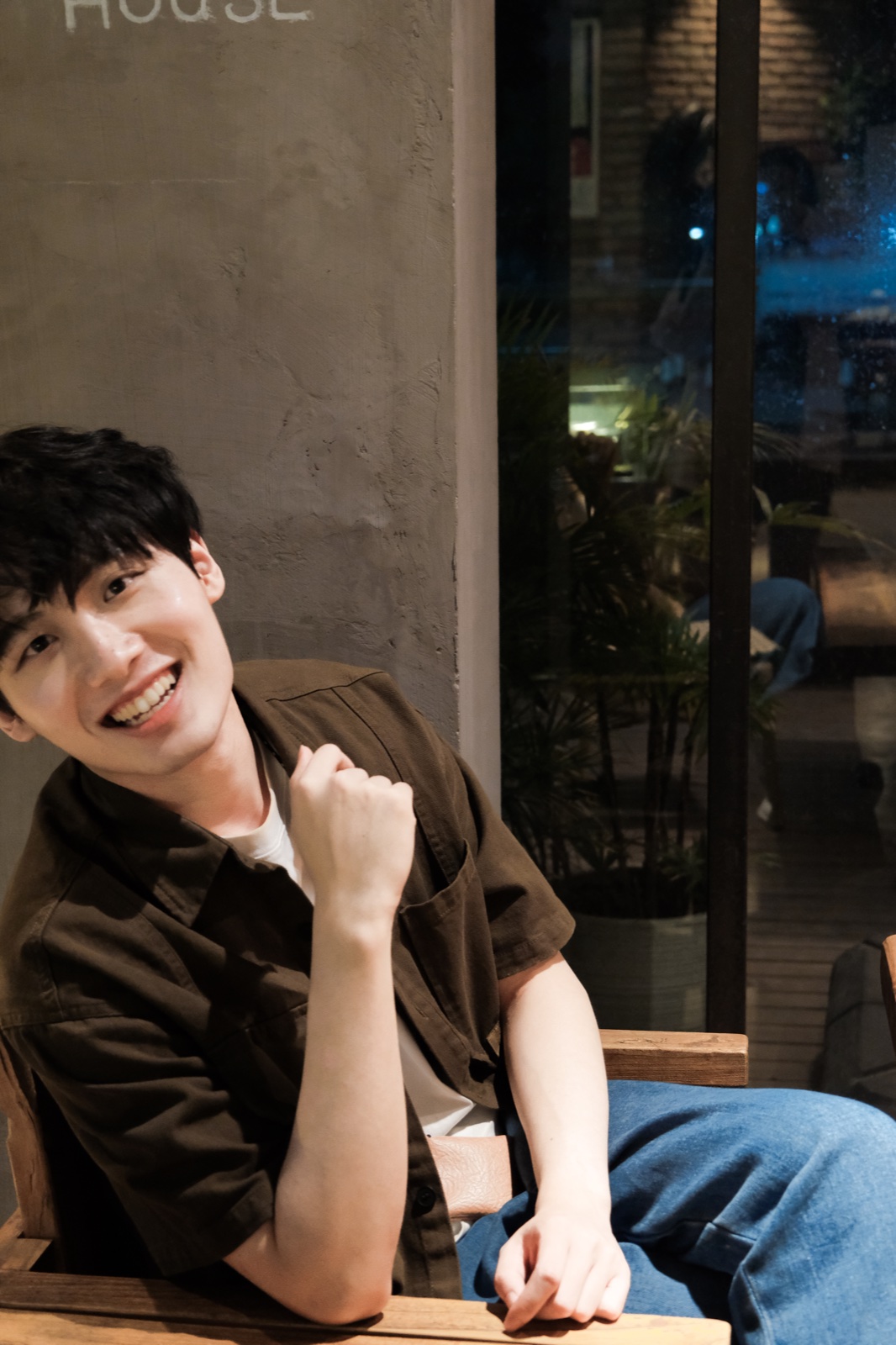
Portrait of Haocun Ye

Recent news

  • CRAFT — The Diagnosis Is Already in the Notes — accepted to Findings of EMNLP 2026 (first author).

  • KnowMeBenchV2 accepted to the EMNLP 2026 main conference (co-author).

  • Received the ICT Outstanding Master’s Student Award.

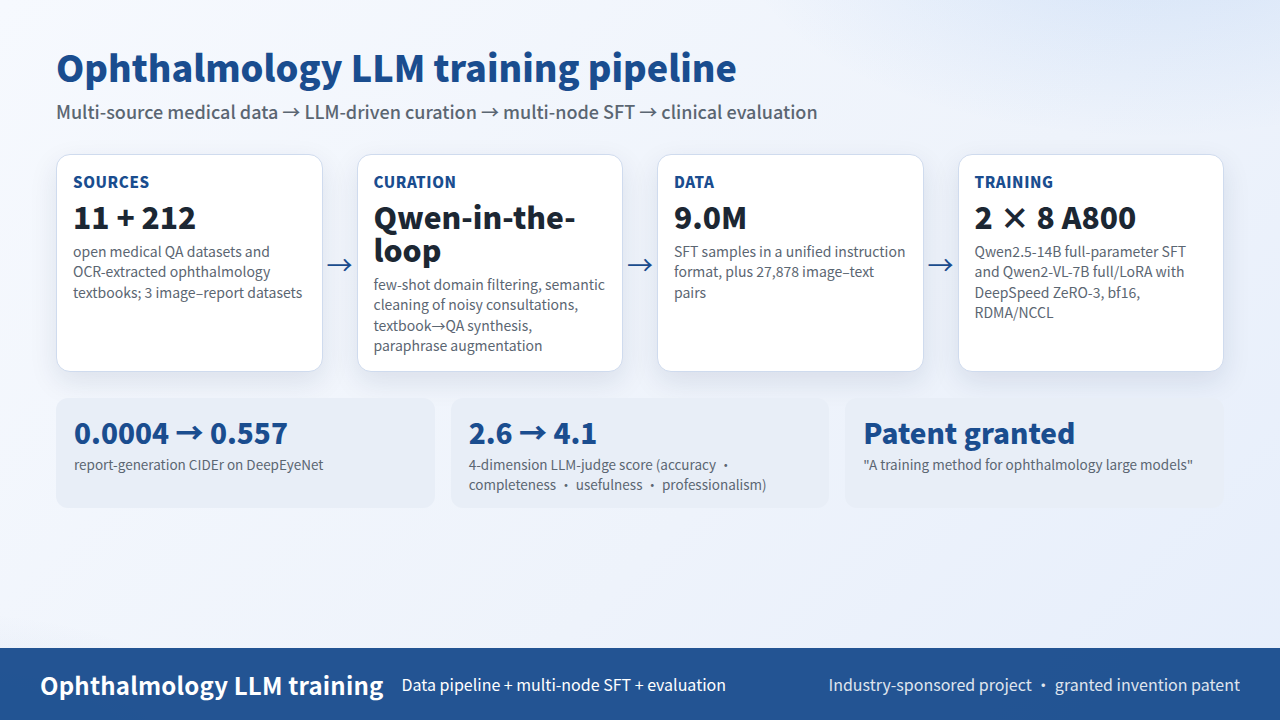
  • Invention patent granted: a training method for large models in ophthalmology.

  • VersaFusion presented at AAAI 2025 (first author).

Selected publications

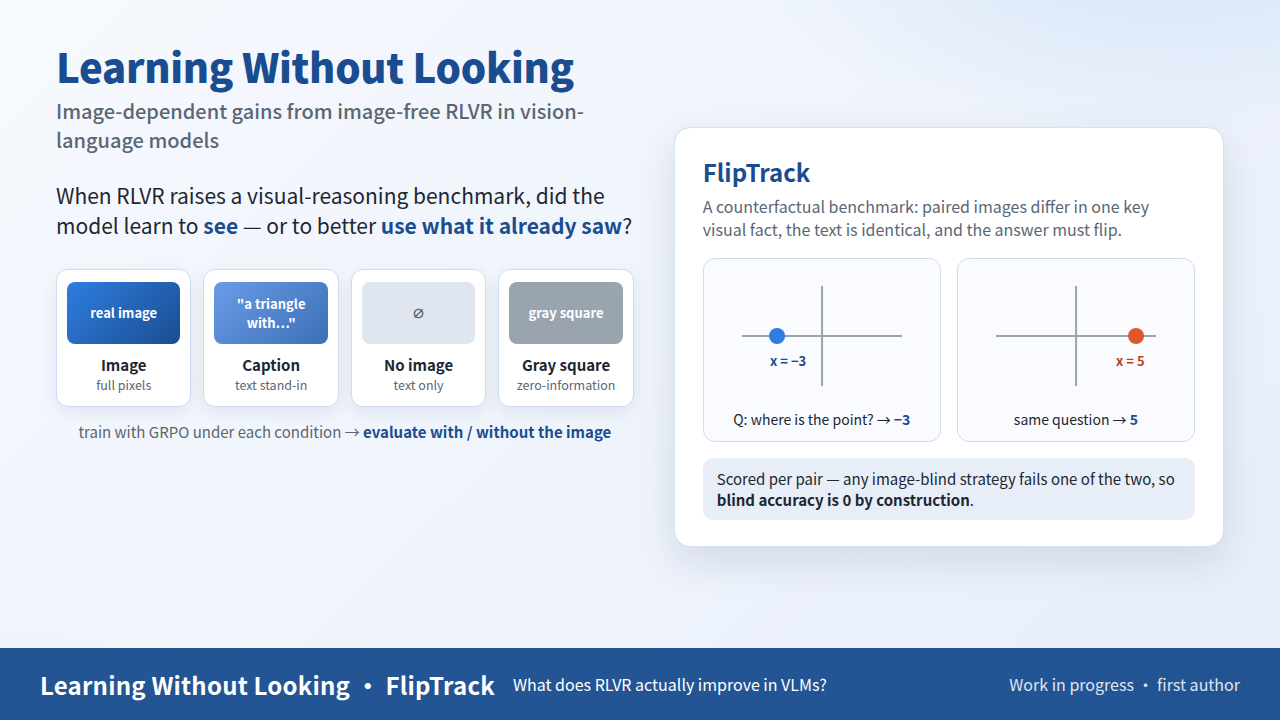
  1. Conceptual cover of Learning Without Looking

    Learning Without Looking: Image-Dependent Gains from Image-Free RLVR

    Haocun Ye et al.

    In preparation

    When RLVR lifts a vision-language model’s visual-reasoning scores, is the model learning to see — or just learning to take the test? Standard benchmarks can’t tell the two apart. A controlled train × test visual-visibility design separates the sources of the gain, and FlipTrack — paired images differing in one key visual fact, scored so the answer must flip — makes text-prior-only strategies score zero by construction. The recurring pattern: scores can rise while reliance on the image quietly degrades. Code and benchmark will be released with the paper.

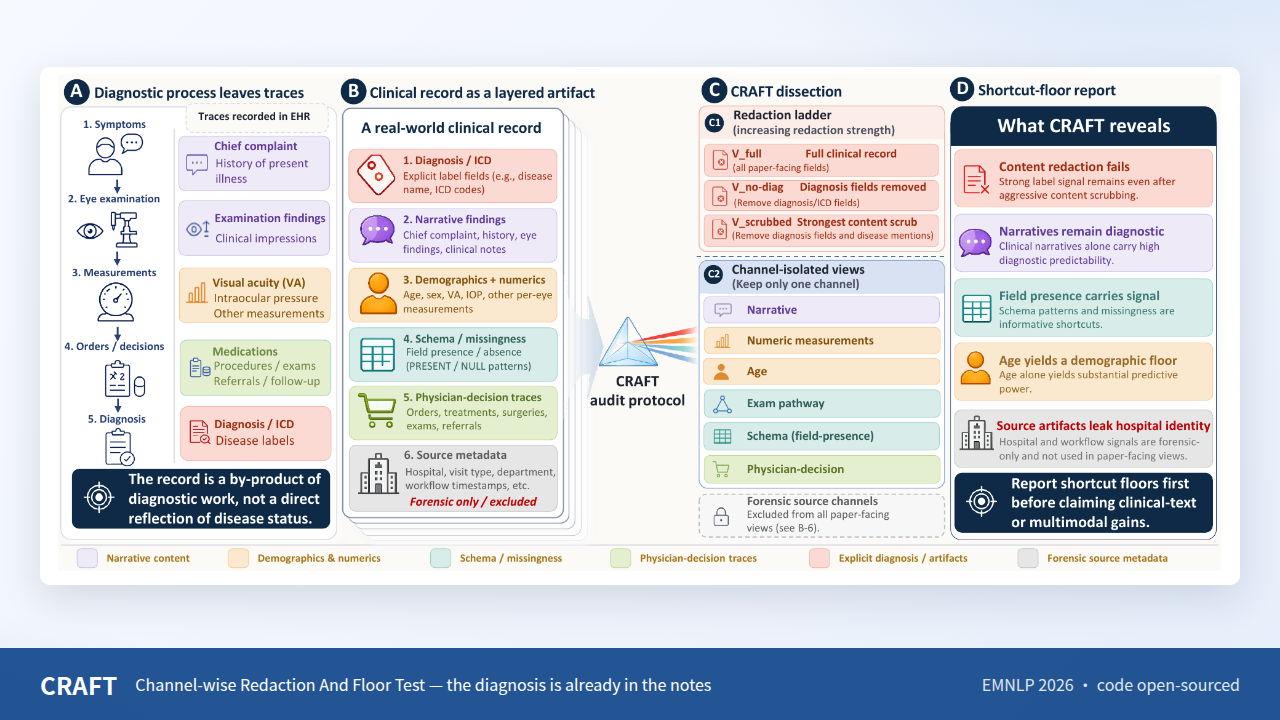
  2. CRAFT channel-wise audit overview

    The Diagnosis Is Already in the Notes: A Channel-Wise Audit of Diagnostic Shortcuts in Clinical-Text Benchmarks

    Haocun Ye, Xinlong Jiang, Yuanyuan Hu, Shubai Chen, Tingyu Wu, Zhenkun Zheng, Caijiao Yi, Teng Zhang, Liuxin Wang, Tong Zhao, Heping Xu, Weiwei Dai, Yiqiang Chen

    Findings of EMNLP 2026

    Diagnosis-redacted clinical records still recover the diagnosis at 0.944 macro-AUROC. CRAFT is a portable audit protocol that reports each channel’s shortcut floor, so fusion gains are read against what the text alone already gives away.

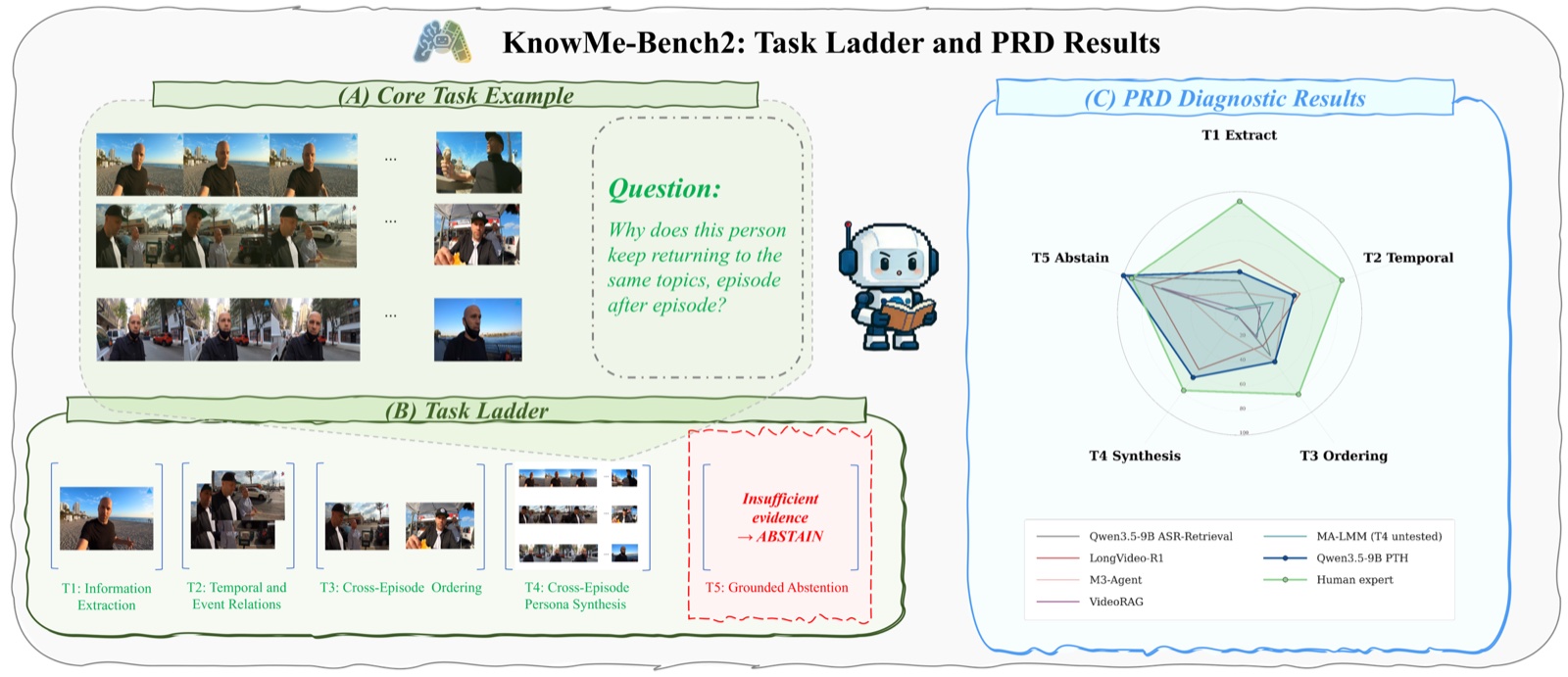
  3. KnowMeBenchV2 overview: five-task ladder from information extraction to grounded abstention, with per-task diagnostic results

    KnowMeBenchV2: Evidence-Grounded Person-Centric Long-Video Understanding

    Tingyu Wu, Guangyu Cao, Qizhen Lan, Zhisheng Chen, Ziyan Weng, Bingkun Zhu, Miao Su, Chenglong Li, Zhengwei Xie, Huacan Wang, Sen Hu, Haocun Ye, Nan An, Zaoqu Liu, Ronghao Chen

    EMNLP 2026

    An evaluation-only benchmark for evidence-grounded, person-centric long-video understanding.

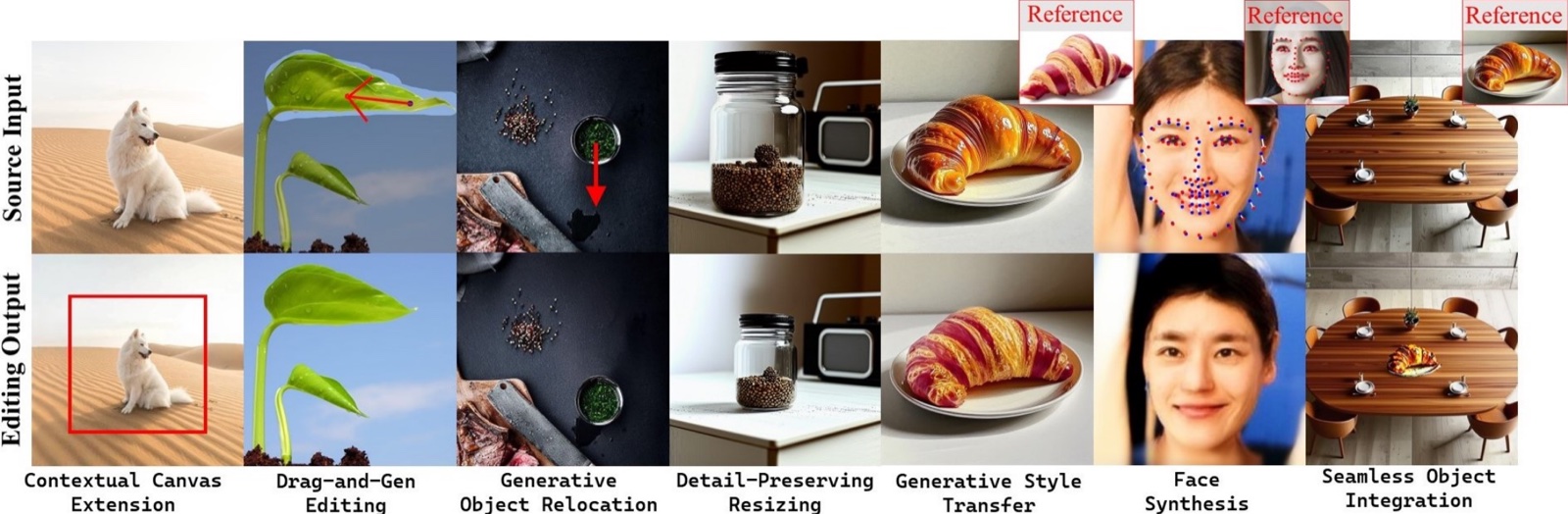
  4. VersaFusion editing examples across seven tasks, from canvas extension and drag editing to style transfer and face synthesis

    VersaFusion: A Versatile Diffusion-Based Framework for Fine-Grained Image Editing and Enhancement

    Haocun Ye, Xinlong Jiang, Chenlong Gao, Bingyu Wang, Wuliang Huang, Yiqiang Chen

    AAAI 2025

    A tuning-free dual-branch framework for fine-grained editing: a guidance branch reconstructs the source and stores its self-attention K/V, a generation branch edits under feature-correspondence guidance and masks, with proximal negative-prompt inversion in place of null-text optimization. One set of weights covers outpainting, resizing, style transfer, drag and face editing. AAAI 39(9), 9445–9453.

Patent · Granted A Training Method for Large Models in Ophthalmology — invention patent behind the ophthalmology LLM training pipeline.

Things I’ve built

Learning Without Looking project cover
01 / 04

Learning Without Looking · FlipTrack

Is RLVR teaching the model to see, or to take the test? Training Qwen2.5-VL with GRPO under four visual conditions — real image, caption, text-only, gray placeholder — and testing each with and without images separates where the gains come from. FlipTrack, a counterfactual benchmark of paired images whose answers must flip, scores text-prior-only strategies at zero by construction. The pattern: benchmark scores can rise while the model’s reliance on the image quietly degrades.

  • RLVR
  • GRPO
  • Qwen2.5-VL
  • Benchmark design
CRAFT project cover
02 / 04

CRAFT — The Diagnosis Is Already in the Notes

Does image–text fusion actually use the image? On 5,904 real visits across Aier Eye Hospital sites, a deliberately weak probe — frozen encoder, one linear head — still recovers the diagnosis from diagnosis-redacted records at 0.944 macro-AUROC; even a view keeping only which fields were filled in reaches 0.854, because which exams were ordered is itself a clue. CRAFT packages this as a portable audit: report each channel’s shortcut floor before claiming a fusion gain. I led the trustworthy-evaluation work; the code is open-source and is becoming a pre-release dataset check.

  • Clinical NLP
  • Shortcut learning
  • Benchmark audit
Ophthalmology LLM training pipeline cover
03 / 04

Ophthalmology LLM Training Pipeline

General-purpose LLMs answer ophthalmic questions vaguely, and public ophthalmic QA corpora are scarce — so this industry project built the corpus first: 610k items filtered from 11 open medical QA sets, 208k QA pairs generated from 212 OCR’d textbooks, paraphrase-augmented to 9.0M instructions. Then full-parameter SFT of Qwen2.5-14B on 2 × 8 A800s (DeepSpeed ZeRO-3, bf16, global batch 1024, RDMA / NCCL). A four-dimension LLM-judge score — medical accuracy, completeness, clinical usefulness, professionalism — rose from 2.6 to 4.1; the method was granted an invention patent. I was a core member and took the project through its final wrap-up.

  • SFT
  • DeepSpeed ZeRO-3
  • Data pipeline
  • Qwen2.5-14B
VersaFusion editing examples from the AAAI 2025 paper: seven editing tasks with source inputs and edited outputs
04 / 04

VersaFusion: Tuning-Free Fine-Grained Image Editing

Text-to-image models generate well but edit poorly: text instructions miss their target, and drag-style methods either inherit GAN backbones or fine-tune per image. VersaFusion’s dual branches edit with no tuning at all — 5.23 s preparation versus 63.56 s for DragDiffusion, with the best point-alignment error and FID among general-purpose methods — and one set of weights covers outpainting, resizing, style transfer, drag and face editing. (AAAI 2025)

  • Diffusion models
  • Image editing
  • Stable Diffusion

Beyond the benchmarks

I’m Haocun Ye, a PhD student in artificial intelligence at the Institute of Computing Technology, Chinese Academy of Sciences, advised by Prof. Yiqiang Chen.

I work on multimodal large models — how they are trained, how they are post-trained with reinforcement learning, and how they should be evaluated. The question that drives most of my work is simple to state and hard to answer: when a benchmark score goes up, did the model actually acquire the ability the benchmark claims to measure?

Away from the lab I like experimenting in the kitchen, and I’m happiest on days off spent with family, travelling with friends, or around a board-game table — ideally with a dog nearby. In quieter hours I play single-player games (GTA, The Witcher 3, Sekiro). I know I have my share of flaws, and I try to keep improving — both in how I work with others and in myself.

Education
PhD student (integrated master’s–PhD track), Institute of Computing Technology, Chinese Academy of Sciences · 2023 – 2028 (expected)
Advisor & lab
Prof. Yiqiang Chen · Beijing Key Laboratory of Mobile Computing and Pervasive Devices
Award
ICT Outstanding Master’s Student Award, 2025
Languages & tools
Python · C++ · Linux / Git · PyTorch · DeepSpeed · Transformers / Diffusers
Training & post-training
Full-parameter / LoRA SFT · multi-node multi-GPU training (ZeRO-3, NCCL) · multimodal RLVR (GRPO / EasyR1) · diffusion inversion & editing
Data & evaluation
LLM-driven data filtering / cleaning / synthesis · benchmark construction & trustworthy evaluation (counterfactual, shortcut & leakage audits) · LLM-as-judge
Models
Qwen3.5 / Qwen2.5 series (incl. VL) · InternVL3 · Gemma-3 · Stable Diffusion
Get in touch

Open to research collaboration and conversations about multimodal models, post-training, and evaluation. Email is the fastest way to reach me.

Institutional: yehaocun23s@ict.ac.cn